

In this article you'll find everything you need to know about Black Friday strategy for ecommerce in 2026. It's written and kept up to date by Mattia Chiaruttini, ecommerce marketing consultant since 2016. Read it to the end, and if you have questions, send me a message.
A Black Friday strategy for ecommerce that actually makes money is decided at least six weeks out, not on Thanksgiving night by slapping 30% off everything. This year Black Friday falls on Friday, November 27, 2026, and Cyber Monday on November 30. If you're reading this in mid-October, you're right on time. Below is the week-by-week plan I use with my clients, the 2025 numbers that shape it and the math to do before you touch a single price.
If you'd rather have someone run it with you, that's exactly what I do as an ecommerce consultant and in Meta Ads and Google Ads management.
In short
- Your peak isn't necessarily Black Friday: on Google Trends, advent calendars climb from October and Christmas gift searches peak between December 7 and 20. Check your own curve before you set dates.
- Cyber Week is the event now: US shoppers spent $44.2 billion online in Cyber Week 2025, and $137.4 billion between November 1 and December 1.
- Math first, discount second: a 30% discount can cut your margin per order from $22 to $7. Bundles and gifts over a threshold usually earn far more.
- Build the list in October: ad costs climb through November, so collect emails and phone numbers early and reach them for free on the big days.
- Test while mistakes are cheap: creative goes into testing in early November; in Cyber Week you only scale what already won.
- The real profit comes after: a new November customer is the cheapest one to bring back before Christmas.
When is Black Friday 2026 and how far ahead should you plan?
Black Friday 2026 is Friday, November 27. Thanksgiving is the day before, Small Business Saturday is November 28 and Cyber Monday is November 30. Plan for six weeks: two for numbers and offer, one for the waitlist, one for creative testing, one to check everything else and the last one to push. Six weeks is the minimum: if people start searching for your product earlier, your plan starts earlier too. More on that right after the calendar.
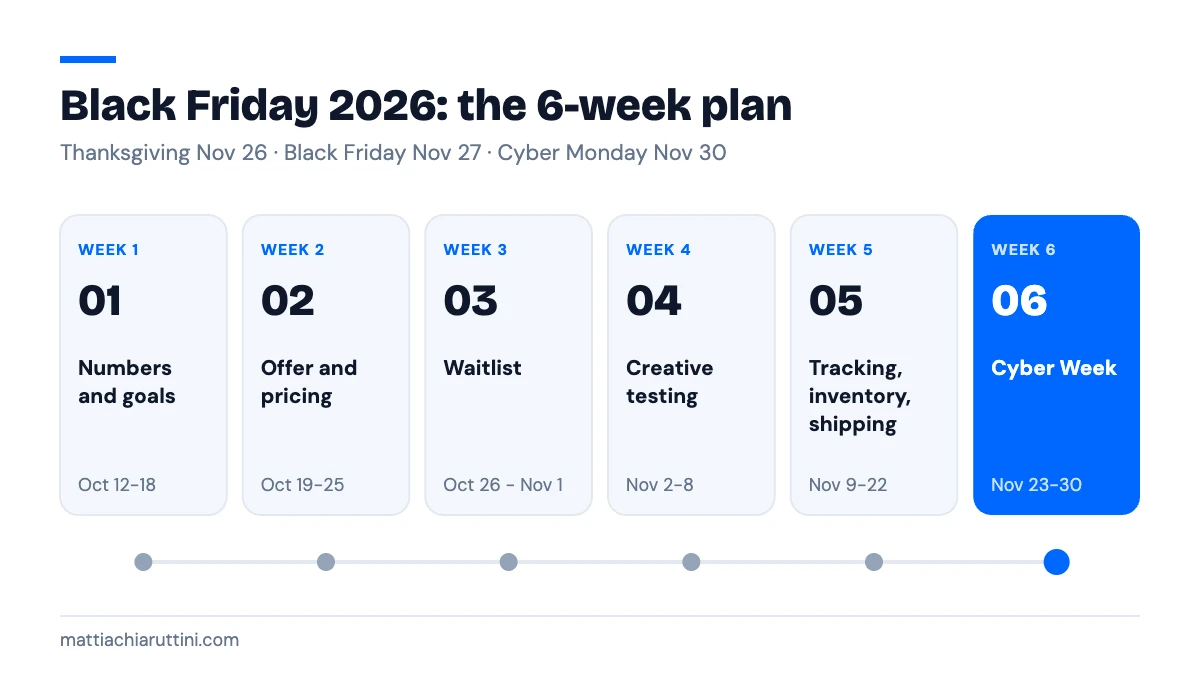
| Week | Dates | What you do |
|---|---|---|
| 1 | Oct 12-18 | Numbers and goals: margin, max CAC, revenue target |
| 2 | Oct 19-25 | Offer: what to discount, what to bundle, what to leave alone |
| 3 | Oct 26 - Nov 1 | Waitlist: signup page, email and SMS, early access |
| 4 | Nov 2-8 | Creative: shoot and test with a small budget |
| 5 | Nov 9-22 | Tracking, inventory, shipping cutoffs, customer support |
| 6 | Nov 23-30 | Cyber Week: Thanksgiving, Black Friday, Cyber Monday |
Less than four weeks out: where to start now
If you're reading this in November, the six-week plan started without you. You don't need to catch up on everything: do first whatever costs you money if it's missing. US search interest gives you a little more room than Italy's: in 2025 “black friday” was at 16% of its peak in the week of November 9 and 29% in the week of November 16, then hit 100 in Black Friday week (Google Trends data I pulled myself). That's when people search, not your deadline: the work has to be done before the jump.
| When | What to do if you start now |
|---|---|
| November 2-8 | Pick the offer from your margin and work out your break-even ROAS at the discounted price. |
| November 9-15 | Open the waitlist and test a few creatives on a low budget. |
| November 16-22 | Check Pixel, Conversions API, inventory and shipping. Set your BFCM ad budget day by day. |
| November 23-30 | Turn the offer on, check orders and MER every day, and don't change everything after one bad day. |
What I'd leave out this year: a new theme or platform, new products and rebuilding the ad account. Those are January jobs.
When does your season actually start? Check Google Trends
The six weeks are counted back from Black Friday. But your customers aren't searching "black friday": they're searching for your product, or for a gift. And every product runs on its own calendar. Here's what Google Trends showed for US searches from September 2025 to January 2026:
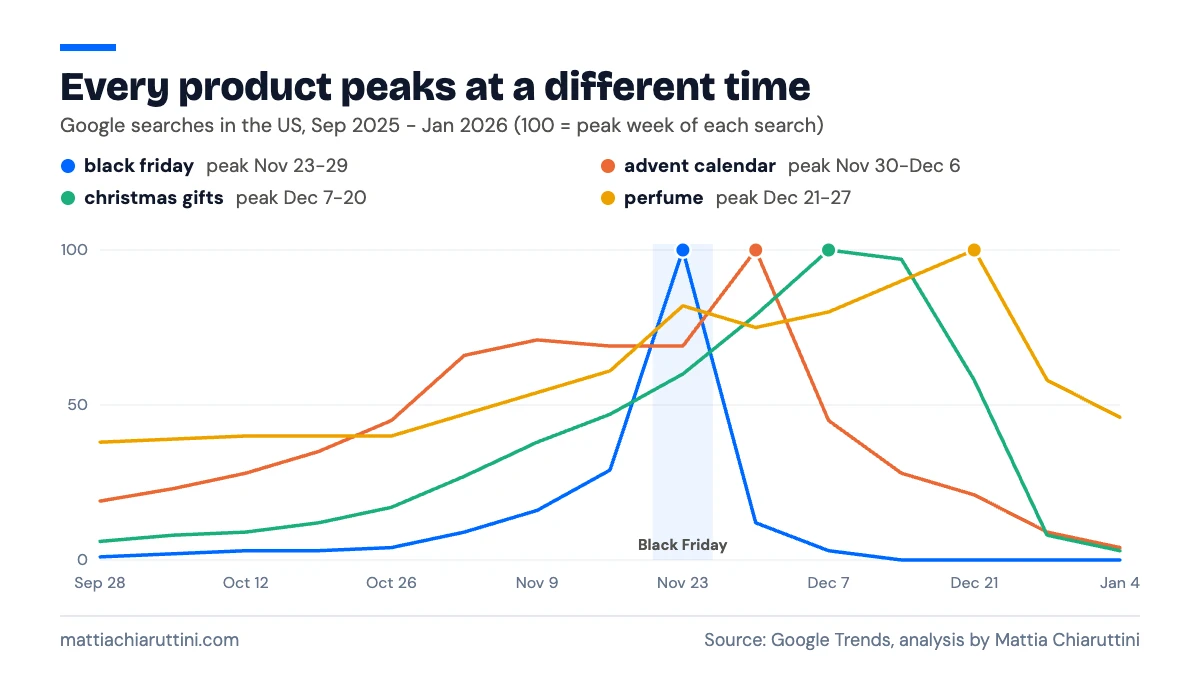
| Search | Starts climbing | Peak week | What it means for your plan |
|---|---|---|---|
| black friday | Early November | Nov 23-29, then it collapses | Your offer should be live in the first week of November |
| advent calendar | Already a fifth of the peak in late September | Nov 30 - Dec 6 | Product, photos and creative ready in October: your plan starts in September |
| winter coat | October | Nov 30 - Dec 6 | A long season: BFCM is a spike inside it, not the whole story |
| christmas gifts, skincare gift set | Early November | Dec 7-20, drops after Dec 21 | Black Friday is only the start: keep budget and stock for the two weeks after |
| toys | Early November | High from Thanksgiving week to mid-December | A plateau, not a spike: pace the budget over four weeks |
| perfume | Mid-November | Dec 21-27 | Last-minute buyers: fast shipping, local pickup, e-gift cards |
| toilet paper | Almost flat: 80% of the peak already in September | Nov 30 - Dec 6, a small bump | For consumables Black Friday is a stock-up moment: bulk packs and subscriptions |
From every curve you need three dates: when it starts climbing (everything has to be ready), the peak week (that's where budget goes) and when it drops (keep stock and creative running until then). The six-week plan starts from the first date, not from Black Friday.
One detail that changes how you pace budget: in the US, searches for "black friday" the week before Thanksgiving are only at 29% of the peak. Almost everything happens in Thanksgiving week itself. In Italy the same week is already at 92%. If you also sell in Europe, your Black Week starts earlier there.
How I run this analysis, in about twenty minutes:
- Google Trends: United States, September 1 to January 31 of last year. Type your product the way a customer would and add "black friday" to get the same scale. Then check the last 5 years to see if the peak repeats.
- Google Ads Keyword Planner: Trends gives you the shape of the curve, not the numbers. Keyword Planner tells you how many searches there really are each month.
- Semrush or Ahrefs: monthly seasonality for keywords and for your competitors' sites.
- Your own data: weekly sales for the last two years from Shopify or GA4, next to Meta CPMs for the same weeks.
- Meta Ad Library: see when competitors switch their campaigns on. Every ad shows its start date.
Search like your customer does. "Face mask" and "skincare gift set" can describe the same product, but they follow two different curves: one is people buying for themselves, the other is people buying a gift. You often need two campaigns on two calendars.
What did Black Friday 2025 tell us?
Before planning this year, look at what happened last year. Four numbers I use to set up the plan:
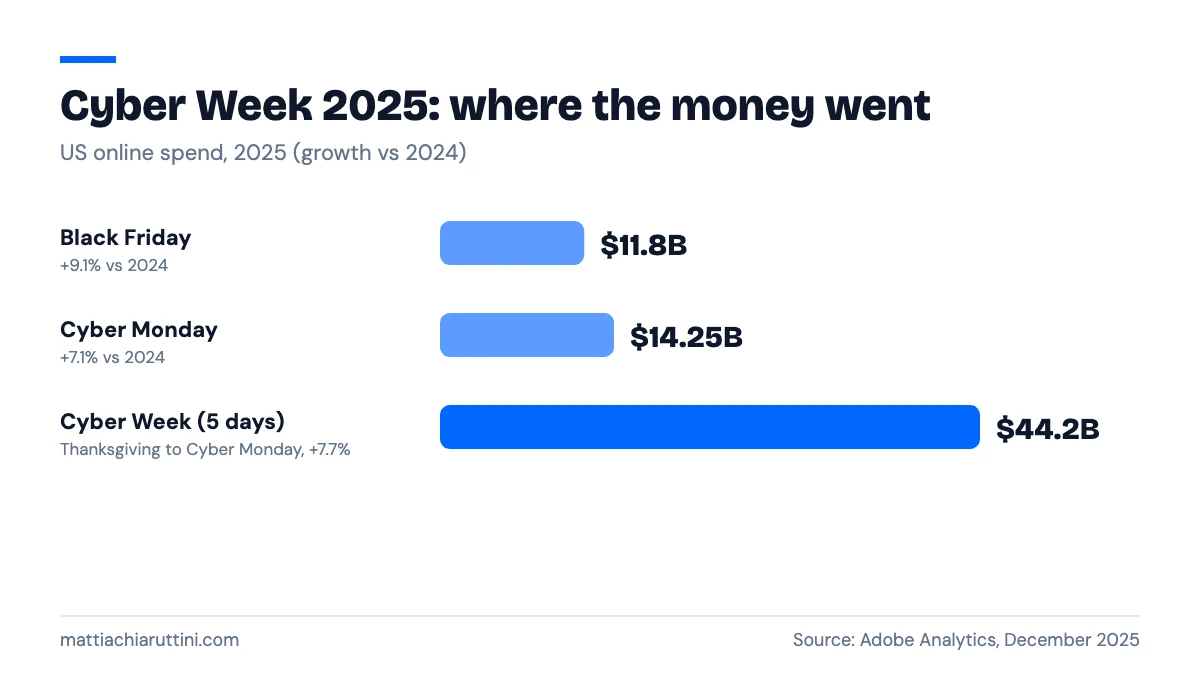
- It's a season, not a day. According to Adobe, US shoppers spent $137.4 billion online from November 1 to December 1, 2025 (+7.2%), and $44.2 billion in Cyber Week alone (+7.7%).
- Black Friday is catching up. Black Friday hit $11.8 billion online (+9.1%), growing faster than Cyber Monday ($14.25 billion, +7.1%). People buy earlier, so your offer has to be live earlier too.
- Ads get more expensive late in November. In GeistM's Meta data, CPMs rose 7% in the second half of October, 3% in the first half of November and 11% in the second half. Stacked up, the end of November cost roughly 22% more than mid-October.
- It happens on a phone. 57.5% of Cyber Monday 2025 online sales came from smartphones, and on Thanksgiving mobile passed 60% for the first time. If your checkout is clunky on mobile, you're losing more than half the game.
In plain terms: sell across the whole season, collect contacts before ads get pricey and make sure checkout works beautifully on a phone.
Black Friday in charts: when shoppers search and when they buy
I turned the Google Trends data I downloaded into charts you can explore: hover (or tap) the points to read the values and switch searches on and off with the buttons. Each search is an index from 0 to 100 against its own peak day, so compare the shape of the curves, not volumes.
US searches, week by week
Weekly average of the Google Trends index, July 2025 to January 2026. Pick the searches to compare.
Cyber Week 2025 in the US, day by day
Each search has its own scale: 100 is that search's peak day. Days around Black Friday are shown.
What it costs to reach people: Meta CPM index
100 = first half of October 2025. Chained changes reported by GeistM: +7%, +3% and +11%.
- Black Friday searches arrive late and fall fast: they barely register before November (4 in the week of Nov 4), reach 13 on Nov 18, 34 in the week of Nov 25 and 2 the week after. Your offer has to be live before the climb.
- Black Friday is not the gifting peak: "christmas gifts" reaches 93 in the week of Dec 9, and "gift cards" 63 in the week of Dec 16 against a base of about 13. Budget and stock have to last through Christmas.
- Cyber Monday has a second day: in 2025, searches for "cyber monday" were at 46 on the Tuesday after, when "black friday" searches were already at 4.
- Reaching people keeps getting more expensive: in GeistM's Meta CPM data, +7% in the second half of October, +3% in the first half of November and +11% in the second, about 22% above the first half of October.
Sources: Google Trends (data downloaded on October 5, 2026) and GeistM.
Why does a discount alone lose you money?
Here's the Black Friday problem: everyone sells more, almost nobody earns more. The discount eats your margin, ads cost more because everyone is buying the same inventory on the same days, and some of those buyers would have paid full price a week later anyway.
Let's run an example with round numbers. You sell a product for $50, it costs you $20 and shipping plus payment fees add $8 per order. At full price you keep $22 per order. With 30% off the price drops to $35 and you keep $7.
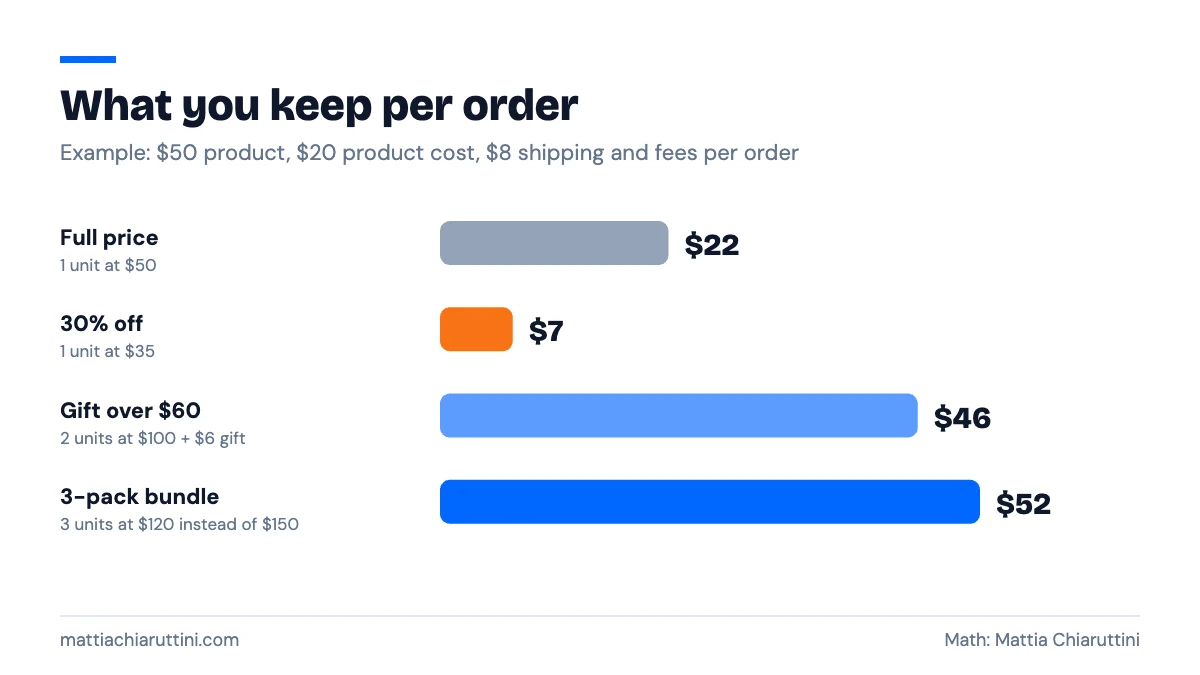
With 30% off you need more than three orders to earn what one full-price order gives you. Worse: that $7 is also the maximum CAC you can pay without losing money on the first order. In the most expensive advertising week of the year, that's a ceiling you'll almost never respect.
The rule I repeat every November: if the cost to acquire a customer goes up, the basket has to go up too. Otherwise you're just paying more to sell for less.
So the right question isn't "how big should the discount be?". It's "how much do I keep on every order?". Three numbers to keep in front of you:
- Margin per order: price minus product cost, shipping, payment fees and any gift.
- Max CAC: how much you can pay for a customer without losing money on the first order.
- AOV: if it goes up, the discount weighs less and fixed per-order costs get spread out.
Is 30% off everything the best Black Friday flash sale strategy?
Usually not. A sitewide 30% off from November 27 to 30 is the easiest offer to launch and one of the most expensive to run. It can work if you have high margins or stock to clear. If you don't, a bundle or a gift over a threshold usually leaves you more on every order.
Same example as above: a $50 product with $28 of costs per order.
| Discount | Price | You keep | Break-even ROAS | Orders to match one full-price order |
|---|---|---|---|---|
| None | $50 | $22 | 2.27 | 1 |
| 10% | $45 | $17 | 2.65 | 1.29 |
| 20% | $40 | $12 | 3.33 | 1.83 |
| 30% | $35 | $7 | 5.00 | 3.14 |
| 40% | $30 | $2 | 15.00 | 11 |
Going from 20% to 30% looks like a small step. Your break-even ROAS goes from 3.33 to 5, in the most expensive ad week of the year.
If you still want the flash sale, I would do four things:
- Give your email list early access, so you are not paying for every sale with ads.
- Exclude low-margin products, or set a minimum order.
- Keep a real start and end date, and do not extend it at the last minute.
- Decide your stop rule before you start: a full day under break-even means you change the offer or cut the budget.
What Black Friday offer works without giving the store away?
Weeks 1 and 2. The temptation is to start with the design. Wrong order: offer first, everything else after. The offers that sell without wrecking margin are almost always these:
| Offer | Margin | Order value | When it works |
|---|---|---|---|
| Sitewide % off | Drops hard | Flat | High margins and stock to clear |
| Bundle | Holds | Goes up | Products used together or reordered |
| Gift over a threshold | Holds | Goes up | You have a gift that costs little but feels valuable |
| Gift box | Holds | Goes up | People buy it for someone else |
| List-only price | Controlled | Flat | You want to reward your audience and grow your list |
- Bundles: more units in one shipment. The customer saves, your AOV goes up and margin holds.
- Gift over a threshold: "spend $60, get X free". Often cheaper than a percentage discount.
- Gift boxes: the season is about gifting, and people buying for someone else look less at price.
- List-only price: a better deal for people who signed up early. It rewards your fans and builds your list.
With BEEQ we push gift boxes exactly in gifting season, when purchase intent is already high. The full reasoning is in the BEEQ case study.
Watch your "was" price. The FTC Guides Against Deceptive Pricing say a former price must be one you actually offered openly for a reasonably substantial period. In California, Business and Professions Code section 17501 generally requires the former price to be the prevailing market price within the three months before the ad, unless you clearly state when it applied. Raising prices in October to "discount" them in November is exactly what these rules target. This isn't legal advice: check with your lawyer.
Want ideas that don't start from the discount? Here are six creative Black Friday campaigns from the last 5 years, with the results that can actually be verified.
How do you build a waitlist before ads get expensive?
Week 3. By late November a Meta impression costs roughly a fifth more than in mid-October. So you collect people early, while they're cheaper, and on Black Friday you reach them for free by email and SMS.
- A "Black Friday early access" page with one field: email (or phone, if SMS is your channel).
- A clear promise: "shop 24 hours before everyone else" or "a price only for people on the list".
- Lead campaigns on a modest budget, starting late October.
- A three-email sequence: confirmation, offer preview, doors open.
A good list has one more benefit: on launch day it tells you within hours which product is moving, so you can shift ad budget accordingly.
Which creative should you test before Black Friday?
Week 4. Same as in quiet months: you test when mistakes are cheap, and on peak days you only push what already worked. In early November, put as many angles as you can into testing on a small budget. By the end of the month, keep the top two or three.
- The plain offer: product, price, deadline. Simple, often unbeatable.
- The gift: "no idea what to get them?" with the box in hand.
- The founder on camera: who you are, why you make this, what's on offer.
- Reviews: real customers explaining the product better than you can.
- The list: "sign up and shop first", running from late October.
The best-performing creative is rarely the most expensive. BEEQ's founders still shoot ads themselves: more ideas tested, less waiting.
What should you check before the peak: tracking, inventory and shipping
Week 5. The boring week, and the one that makes the difference. If Meta can't see your sales, it optimizes blind, and in late November blind gets expensive.
- Pixel and Meta Conversions API live, with no duplicate events.
- Google Ads conversions and your Google Merchant Center feed updated with sale prices.
- Checkout tested on a phone, start to finish: more than half of orders will come from there.
- Inventory checked on the offer products: running out of your bestseller on Friday morning is a classic.
- Holiday shipping cutoffs published clearly, especially for gift buyers.
- Saved replies ready for the questions you'll get a hundred times (returns, delivery dates, discount codes).
How should you manage Meta Ads budget during Cyber Week?
Week 6. On peak days CAC goes up for everyone. Don't panic, but watch the right numbers: platform ROAS tends to look inflated, MER (total revenue divided by total marketing spend) doesn't.
- Scale budget gradually on the campaigns and creative that already won in testing; don't double it overnight.
- Keep part of the budget for retargeting people on your list and cart abandoners.
- Check the numbers every day, not at the end of the week.
- Decide in advance the CAC at which you cut: you choose better with a cool head.
How do you know if Black Friday actually made you money? Check the P&L
Black Friday revenue is the prettiest number and the least useful one. To know whether you made money you need the P&L (profit and loss): every line in order, from gross sales to profit. Build it for the Black Friday month and put it next to a normal month.
| P&L line | How to calculate it | What to check after Black Friday |
|---|---|---|
| Discounts | % of gross sales | How much you gave away compared with a normal month |
| Returns | % of gross sales | If they rise, part of those sales was pure impulse |
| Cost of delivery | Product, shipping, pick and pack and payment fees, as % of net sales | Discounts push this percentage up even when costs stay the same |
| Ad spend | % of net sales | It rises in peak month: margin has to rise with it |
| Contribution margin | Gross margin minus marketing spend | The number that tells you whether Black Friday worked |
| First-order profit | First-order margin minus the cost to acquire a new customer | If it's negative, Black Friday only pays off if those customers come back |
A simple benchmark is Common Thread Collective’s 4 Quarter Accounting: cost of delivery, ad spend, operating expenses and profit should each take roughly a quarter of revenue. In Black Friday month ad spend can go over its quarter, but only if contribution margin holds or you have a real plan to bring new customers back.
Watch the averages. Go back to the earlier example: if half your orders are a single discounted unit at $35 and the other half are the $120 bundle, your average order value is $77.50 and looks healthy. But half your orders leave you $7 and the other half $52. Look at orders by price band, not just the average.
What should you do after Black Friday to keep new customers?
The real profit comes later. Someone who bought in November is the cheapest customer to bring back in December: you already know them, you have their email and you don't have to pay Meta to find them again.
- A thank-you email and a review request after delivery.
- A second-purchase offer before Christmas shipping cutoffs.
- New customers excluded from acquisition campaigns, so you don't pay for them twice.
The most common Black Friday mistakes
- Picking the discount before doing the math. If you don't know what you keep per order, you don't know what you can spend on ads.
- Starting on Friday. The 2025 data says the season matters more than the day.
- Testing in Cyber Week. It's the most expensive week of the year to be wrong.
- Inflating the "was" price. It can break pricing rules and it costs you customer trust.
- Forgetting December. Without a second-purchase plan, Black Friday stays a one-off spike.
Black Friday ecommerce checklist: 81 tasks to tick off and download
This is the checklist I would use for an ecommerce brand, ordered by area and date, with 2026 deadlines. Tick tasks off below (your ticks stay in your browser) and, if you want to work through it with your team, download the free CSV with priorities, how to verify each item and Owner, Status and Notes columns.
Recap: your Black Friday 2026 checklist
For the full version, with deadlines and how to verify each item, use the interactive checklist above, which you can also download as a CSV.
- Clear numbers: margin per order, max CAC, AOV.
- Offer locked by late October: bundles, gifts, gift boxes, list-only price.
- Honest reference prices that follow FTC and California rules.
- Waitlist live by early November.
- Creative tested before the peak.
- Tracking, feed, mobile checkout, inventory and shipping cutoffs checked.
- Budget that scales gradually and a daily MER check.
- A P&L for Black Friday month, next to a normal month.
- A second-purchase plan before Christmas.
Black Friday for ecommerce: frequently asked questions
When is Black Friday 2026?
Friday, November 27, 2026. Thanksgiving is Thursday, November 26, and Cyber Monday is November 30. Cyber Week runs from Thanksgiving through Cyber Monday.
When should I start planning for Black Friday?
At least six weeks out, so mid-October. But check Google Trends first: if searches for your product start climbing in October, like advent calendars and winter coats, your plan should start in September.
How do I find out when people start searching for my product?
In Google Trends, set the United States and the period from September 1 to January 31 of last year, search your product the way a customer would and compare it with "black friday". Note when the curve starts rising, the peak week and when it drops. For real volumes, use Google Ads Keyword Planner.
Is a percentage discount or a free gift better?
In most cases a gift with purchase over a threshold, or a bundle, protects margin better and lifts average order value. Run the margin-per-order math before you choose.
How much should I spend on ads during Cyber Week?
There's no universal number. Start from the maximum CAC your offer can afford and scale budget gradually, only where the numbers hold.
Should I run Black Friday if my margins are thin?
Yes, but not with a sitewide discount. Thin margins work better with early access for your list, bundles, gifts over a threshold or a deal on a few hero products.
What 'was' price can I show next to a sale price?
Under the FTC Guides Against Deceptive Pricing it must be a real price you offered openly for a reasonably substantial period. In California, the former price generally has to be the prevailing market price within the previous three months, unless you clearly state when it applied. When in doubt, ask your lawyer.
How do I know if Black Friday really went well?
Not from revenue. Look at the month’s P&L: discounts, returns, cost of delivery, ad spend and above all contribution margin, compared with a normal month. Also check whether new customers’ first order is profitable.
Black Friday or a full Cyber Week?
Spending is spread across the whole season, and Black Friday alone is no longer the whole story. A Cyber Week offer works if you have enough stock and a real reason to buy now, like early access for your list.
Let's talk about your store
A 30-minute call to understand where you are, where you want to go and whether I can help. If I'm not the right fit, I'll tell you straight away.