

In this article you'll find everything you need to know about Meta Ads strategy for ecommerce in 2026. It's written and kept up to date by Mattia Chiaruttini, ecommerce marketing consultant since 2016. Read it to the end, and if you have questions, send me a message.
Meta got easier to run and harder to win. Targeting is mostly automated now, budgets move on their own and the ad system picks who sees what. So a Meta Ads strategy for ecommerce isn't about finding a clever audience anymore. It's about feeding the machine a better offer, more varied creative and cleaner data than your competitors. This is the playbook I use with DTC brands, from the first euro spent to scaling.
If you'd like someone to run it with you, that's what I do in Meta Ads and Google Ads management and as an ecommerce consultant.
In short
- Creative is the new targeting: Meta says it openly. Broad audiences plus genuinely different concepts beat clever interest stacks.
- Numbers before ads: know your margin per order and maximum CAC before you spend. They set every budget decision.
- Keep the account simple: one main sales campaign, one place to test new concepts, clear rules for existing customers.
- Test concepts, not colors: a new hook or angle teaches you more than a new button.
- Judge on MER and margin: platform ROAS is useful for comparing ads, not for deciding how much to spend.
What changed in Meta Ads, and why the old playbook stopped working?
Three changes between 2024 and 2026 rewrote how ecommerce accounts should be run.
- The ad system got much better at matching ads to people. Meta's Andromeda retrieval system, rolled out from late 2024, decides which ads even enter the auction for each person. It can handle far more ads than before, and Meta reports an 8% improvement in ads quality.
- Creative replaced targeting as the main lever. In its April 2025 guidance Meta wrote that the focus has shifted from niche targeting to creative diversification. Different themes, messages and visuals help the system find different buyers.
- Automation became the default. In 2025 Advantage+ shopping campaigns became Advantage+ sales campaigns, and the streamlined Advantage+ setup is now the starting point for new sales campaigns.
Measurement changed too. On January 12, 2026 Meta removed the 7-day and 28-day view attribution windows from its reporting API, and many brands saw reported conversions drop overnight without any real change in sales. More on what to do about it below.
| Then | Now |
|---|---|
| Stack interests and lookalikes | Broad audience, let the creative find the buyer |
| Many ad sets, each with its own audience | Few campaigns, budget pooled where learning happens |
| Test button colors and headlines | Test concepts: different problems, promises and formats |
| Trust the ROAS in Ads Manager | Check MER, margin and new-customer cost against your store data |
What do Meta Ads cost for ecommerce brands in 2026?
Useful context before setting targets. Triple Whale tracked Meta performance for more than 40,000 brands from August 2025 to July 2026:
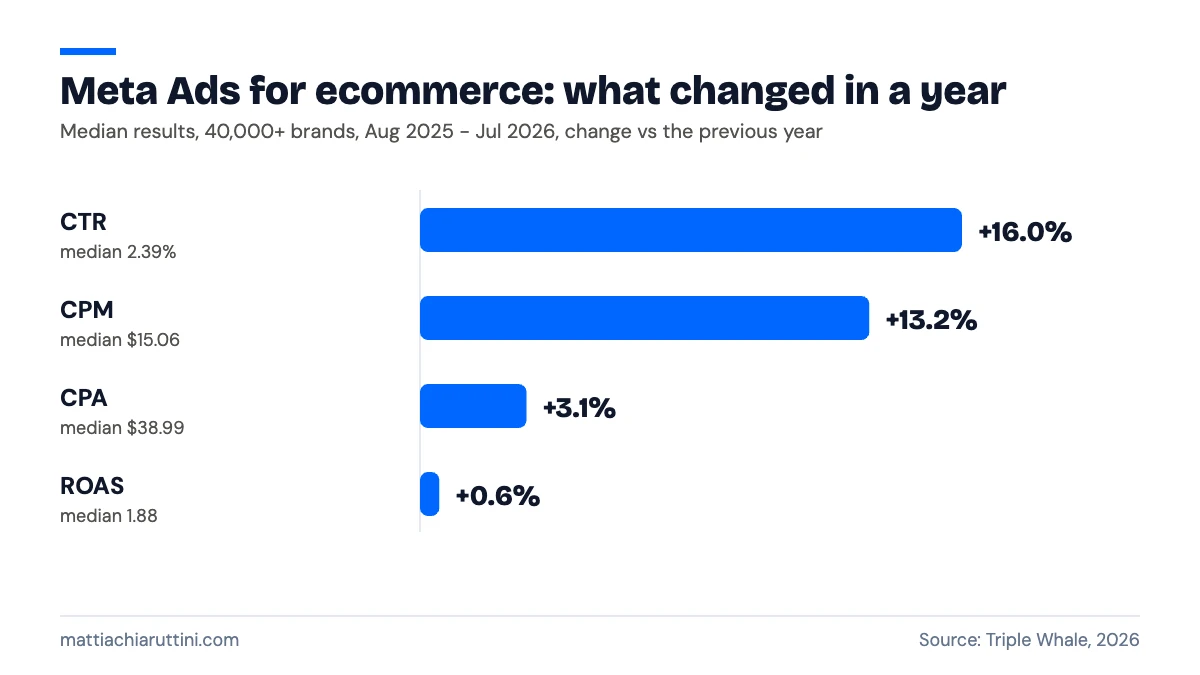
- Reach costs more: median CPM was $15.06, up 13.24% year over year. Sixteen of seventeen industries got more expensive.
- Clicks are cheaper to earn: median CTR rose to 2.39%, up almost 16%. Creative that stops the scroll is working.
- Customers cost about the same: median CPA was $38.99 (+3.14%) and median ROAS 1.88.
- Meta is still the main channel: brands in the dataset put 66.88% of their ad budget on Meta.
- Your category changes everything: Health & Wellness had the highest median CPM at $21.80, Baby the lowest at $11.50.
Read these as a sanity check, not a target. A 1.88 ROAS can be great for a brand with high margins and repeat purchases, and a disaster for a low-margin one-off product.
Why the offer and the numbers come before the ads
Most Meta problems I'm asked to fix aren't Meta problems. They're offer problems, margin problems or website problems that show up in Ads Manager as a high cost per purchase.
Before launching anything, write down three numbers: margin per order after product, shipping and fees, the maximum CAC you can pay on the first order, and your AOV. If a new customer is worth more over time, because they reorder, note how much and how fast. I walk through this math with real numbers in the Black Friday strategy guide.
My rule: if the cost to acquire a customer goes up, the basket has to go up too. Bundles, gift sets and free-shipping thresholds are often the cheapest way to make Meta profitable again.
How should you structure a Meta Ads account for ecommerce?
Simple beats clever. Every extra campaign splits your budget and slows down learning. Here's the structure I start from:
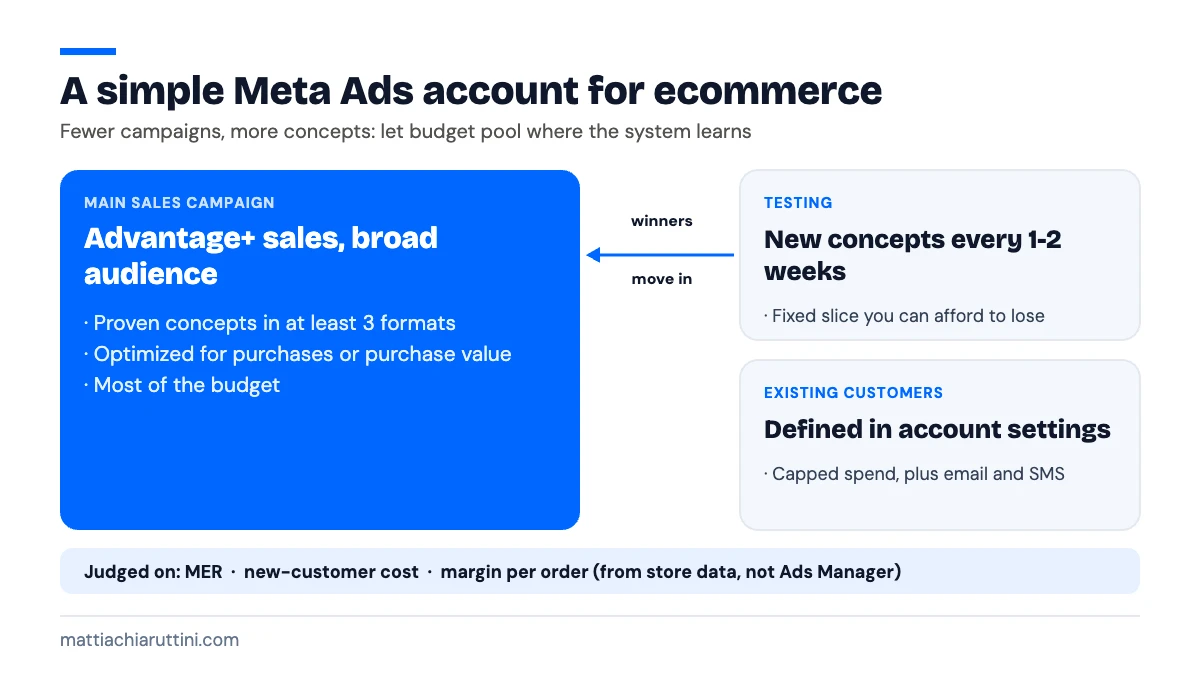
| Campaign | What it does | Budget |
|---|---|---|
| Main sales campaign (Advantage+) | Broad audience, the concepts that already work, all placements | Most of the budget |
| Testing | New concepts every week or two, judged on the same goal | A fixed slice you can afford to lose |
| Existing customers | Rules so you don't pay to reach people who buy anyway | Capped, or handled by email and SMS |
- Optimize for purchases (or purchase value once you have enough volume), not for clicks or add-to-carts.
- Go broad and let Advantage+ audience work. Use exclusions only for people you really don't want to pay for.
- Define your existing customers in the account settings, so reports split new and returning buyers and you can limit spend on people who already buy.
- Keep the testing slice fixed. When a concept wins, move it into the main campaign instead of scaling the test.
Creative is the new targeting: what to make and how much
If the system finds the audience, your creative decides which audience it finds. A skincare ad about redness reaches different people than one about a five-minute routine, even with the same targeting. That's why variety matters more than polish.
Meta's own example: an ecommerce brand quoted in its guidance went from three or four new creatives a week to almost 50 while keeping performance steady, by producing them in-house. You don't need 50. You need enough genuinely different ideas in the market at all times.
| Angle | What it says | Formats that fit |
|---|---|---|
| The problem | Name the pain in the customer's own words | Talking-head video, static with a quote |
| The result | Show the before and after, or the outcome | Short video, carousel |
| The founder | Who you are and why you make this | Selfie video, behind the scenes |
| Social proof | Real reviews, numbers, press | Review screenshots, UGC, partnership ads |
| The objection | Answer the reason people don't buy | FAQ-style video, comparison static |
| The offer | Bundle, gift, deadline | Static, catalog ads |
At BEEQ the founders, Sabrina and Andrea, still film the ads themselves. It's not a budget compromise: it's why they can test more ideas than brands ten times their size. The full story is in the BEEQ case study.
Concept, angle, format: three different things. Changing the background color is a variation. Changing the problem you talk about is a new concept. Only new concepts teach the system to find new buyers.
Which ad formats work best for ecommerce?
Formats are where the same idea meets different people. Most accounts I see run too few of them.
| Format | Best for | Watch out for |
|---|---|---|
| Vertical video (Reels, Stories) | New concepts, founder and creator content, demos | The first two seconds decide everything |
| Static image | Clear offers, reviews, comparisons; fast to produce and test | Fatigues quickly, refresh often |
| Carousel | Several products, steps, before and after | Lower attention per card |
| Catalog ads (Advantage+ catalog) | Large catalogs, retargeting viewers of specific products | Needs a clean product feed and good photos |
| Partnership ads | Running ads from a creator's account, with their audience's trust | Agree usage rights and duration in writing |
A healthy main campaign mixes at least three formats. The system will put each one where it performs best, but only if you give it the choice.
How do you test creative without wasting budget?
- Batch it. Launch new concepts on a fixed day, every week or two, so you can compare like with like.
- One idea per concept. Two or three variations of the same idea are fine; mixing ideas makes results unreadable.
- Give it a fair chance. Don't kill a concept after a day. Let it spend at least your target CPA before you judge it.
- Read the funnel in order. Does it stop the scroll (hook rate), hold attention, get clicks, then purchases at an acceptable cost?
- Decide and move. Winners go into the main campaign, near-misses get a new hook, losers are switched off. Write down what you learned.
Before you start, browse the Meta Ad Library: you'll see which ads competitors keep running for months. Long-running ads are usually the profitable ones.
To see what high-volume testing looks like at a company that's scaling, read how many creatives Wispr Flow ships.
How much should you spend on Meta Ads?
There's no right number for everyone, but there's a right way to find yours.
- Start from the maximum CAC your margin allows and estimate how many purchases a week you need for the system to learn.
- Separate a test budget from a scaling budget. BEEQ's first campaign ran at €30 a day in July 2023. Small, but enough to learn.
- Scale in steps, not by doubling overnight, and only while new-customer cost and MER hold.
- Plan for seasonality. Test in flat months, push in peak months. Ad costs rise in late November and December.
For peak season, check on Google Trends when searches in your category actually start: for some products it's October, for others mid-December. The Black Friday guide linked above shows how to read those curves.
Which Ads Manager metrics actually matter?
Ads Manager shows dozens of columns. These are the ones I read, in this order, always compared with your own account's averages rather than with someone else's benchmarks:
| Metric | What it tells you | When to worry |
|---|---|---|
| Hook rate (3-second views / impressions) | Does the first second stop the scroll? | Clearly below your other videos: change the opening, not the whole ad |
| Hold rate (ThruPlays / 3-second views) | Does the story keep people watching? | People stop early: cut the intro, get to the point faster |
| Link CTR | Does the ad make people want to know more? | Good hook but low CTR: the promise or the offer is weak |
| CPM | How expensive the audience and the season are | Rising fast with no seasonal reason: creative fatigue or a narrow audience |
| Conversion rate after the click | Does the page close the sale? | Good CTR, few purchases: fix the page, price or checkout |
| Cost per purchase (new customers) | What a new buyer really costs | Above your maximum CAC for more than a week |
| Frequency | How often the same people see your ads | Rising with falling results: you need new concepts |
How do you measure Meta Ads after the 2026 attribution changes?
Meta's reported conversions are an estimate. Since view-through windows were cut in January 2026, the numbers in third-party reports can look worse than before even when sales haven't changed. The fix isn't to panic, it's to measure from your own data.
- Pixel plus Conversions API, with deduplication, so Meta sees purchases that browsers block.
- A weekly check of MER: total revenue divided by total marketing spend, from your store, not from Ads Manager.
- New-customer cost: spend divided by first-time buyers. This is the number that tells you if Meta is really growing the business.
- A post-purchase survey ("How did you hear about us?") to catch what no pixel sees.
- Platform ROAS only to compare campaigns and creative with each other, always with the same attribution setting.
Meta also offers an incremental attribution setting in Ads Manager, which tries to count only the sales the ads actually caused. It's worth testing on larger accounts. For the full set of numbers I track, read data-driven marketing for ecommerce.
What happens after the click?
Half of Meta performance is decided on your website. A great ad that lands on a slow, confusing page just buys you expensive traffic.
- Message match. If the ad talks about redness, the product page should use the same word, near the top.
- Mobile first. Most Meta traffic is on a phone. Test the checkout on your own phone, start to finish, every month.
- Reviews where the doubt is. BEEQ has over 2,000 positive reviews, and they work hardest next to the price and the add-to-cart button.
- A reason to buy more. Bundles and thresholds raise AOV and give your ads more room to spend.
A 90-day plan to launch or reset a Meta Ads account
This is the sequence I follow when I take over an account or launch a new one. Dates move with seasonality, the order doesn't.
| Weeks | Focus | What you do |
|---|---|---|
| 1-2 | Numbers and tracking | Margin, maximum CAC and AOV. Audit Pixel, Conversions API and deduplication. Define existing customers. |
| 3-4 | Offer and first concepts | Pick the hero offer. Produce 5 to 8 genuinely different concepts in at least three formats. |
| 5-6 | Launch | One main sales campaign on a broad audience with all concepts. Small fixed testing slice. No big changes for the first days. |
| 7-10 | Testing rhythm | New concepts every week or two. Winners into the main campaign, losers off. Weekly MER and new-customer cost check. |
| 11-13 | Scale or fix | If numbers hold, raise budget in steps. If not, go back to the offer or the page before adding spend. |
At the end of the 90 days you should know three things: which concepts sell, what a new customer costs you, and how much budget the account can take before results drop.
When and how should you scale?
You're ready to scale when the main campaign has been stable for a few weeks, new-customer cost is below your limit and you have more winning concepts than you're running. Then you have two directions:
- More budget on what works, in steps, watching MER and new-customer cost every day.
- More reach: new concepts for audiences you haven't spoken to yet, a new product, or a new market.
- A second channel when Meta is mature. For products people already search for, Google Shopping and Performance Max capture the demand Meta creates.
BEEQ pushed one channel to the limit before adding others: most of the budget stayed on Meta while the brand grew from €6K in revenue in 2022 to €518K in 2025.
The most common Meta Ads mistakes in ecommerce
- Too many campaigns. Ten small ad sets learn slower than one well-funded campaign.
- Too few concepts. Running the same three ads for months, then blaming the algorithm when results fade.
- Judging on the wrong number. Celebrating platform ROAS while margin and MER go down.
- Paying for existing customers. Retargeting people who would have bought from your email anyway.
- Changing everything at once. New budget, new creative and new offer in the same week means you learn nothing.
- Fixing ads when the problem is the page. Check the product page and checkout before you blame the creative.
Recap: your Meta Ads checklist for ecommerce
- Margin per order, maximum CAC and AOV written down.
- One main Advantage+ sales campaign on a broad audience.
- A fixed testing slice and new concepts every week or two.
- Existing customers defined and limited.
- Pixel and Conversions API with deduplication.
- MER and new-customer cost checked weekly from store data.
- Product page and mobile checkout tested regularly.
- Scaling in steps, with a plan for peak season.
- A 90-day plan written down before you start.
Meta Ads for ecommerce: frequently asked questions
What is the best Meta Ads strategy for ecommerce in 2026?
A simple account with one main sales campaign on broad targeting, a steady flow of genuinely different creative concepts, clean tracking with the Conversions API, and budget decisions based on margin and MER rather than platform ROAS.
Is detailed targeting still worth it on Meta?
Rarely for ecommerce prospecting. Meta itself says the focus has shifted from niche targeting to creative diversification: the creative now does most of the work of finding the right people. Exclusions and existing-customer settings still matter.
How many ads should I test per month?
There's no magic number, but think in concepts, not ads. A small brand can work well with three to five new concepts a month, each with a few variations. Larger accounts test several concepts a week.
How much should I spend on Meta Ads to start?
Start from the maximum CAC your margin allows and a test budget you can afford to lose while learning. BEEQ's first campaign ran at €30 a day in July 2023. Scale in steps, only where the numbers hold.
Should I use Advantage+ sales campaigns?
For most ecommerce brands, yes, as the main prospecting campaign. Since 2025 the Advantage+ setup is the default for new sales campaigns. Keep control where it matters: offer, creative, exclusions and budget.
Why don't my Meta numbers match Shopify?
Because Meta uses its own attribution rules and view-through windows, and some sales happen without any trackable click. Use Shopify revenue and MER for budget decisions, and Meta's numbers to compare campaigns and creative.
When should I add Google Ads?
When people already search for what you sell, or when Meta is stable and you want to capture the demand it creates. For products people don't search for yet, Meta usually comes first.
Let's talk about your store
A 30-minute call to understand where you are, where you want to go and whether I can help. If I'm not the right fit, I'll tell you straight away.